The Trial We are Waiting For
Julfikar Ali Manik
When Awami League Chief Sheikh Hasina announced her election manifesto in a jam-packed hall room on December 12, everyone was listening with rapt attention. Suddenly her supporters gave a huge round of applause breaking the silence. The jubilant applause was a clear message to Hasina, other politicians, foreign diplomats and journalists in the air-conditioned hall room of a five star hotel where the announcement had been made: even after 37 years people are highly emotional about this long-standing issue.
Hasina’s election pledge about trying war crimes has uplifted the spirits of not only the party workers, but has given hope to the entire nation despite its growing disillusionment from past experience of successive governments including the AL’s, of ignoring this popular demand. Bangabandhu Sheikh Mujibur Rahman’s government had initiated the trial of the war criminals but could not continue due to the horrific events of 1975. The onus had been on all the governments that followed, some of which assumed power illegitimately or legitimately. Sadly, even the elected governments did not make the trial of war criminals a priority.
Hasina is pledge-bound to try the war criminals now as her election pledge about war crime has been endorsed by the ballot. There is little doubt that it was her promise to try war criminals that helped her to bag people’s landslide mandate. After the Grand Alliance’s landslide victory she said, “People have already ‘tried’ the war criminals and the anti-Liberation forces through ballots, but our government would obviously take legal steps to try them.” This, together with Hasina seeking support from the UN to bring war criminals under trial, has given people the hope that she is committed to her promise and intends to carry it out.
Chief of the UN Secretary General’s six-member high-level panel Francese Vendrel has said that it would be up to the new government to take up the matter with the UN Secretary General and make it clear what they want the UN to do. Experts, researchers on war crime and victims of the war crimes are also getting ready to help the government and UN. They think the new government should formally request the UN immediately for its involvement in the trial process.
Ferdousi Priyabhashini, one of the survivors of the 1971 war crimes, says, “I am really optimistic this time about the trial of war criminals. I am also eagerly waiting to deposit my witness as a victim in the war crime tribunal, which should be set up as quickly as possible.” Ferdousi, who is also a renowned sculptor of the country, already gave her testimony in many publications. She was imprisoned and tortured by the Pakistani occupation forces and their collaborators in Khulna during the nine-month liberation war in 1971. She witnessed the genocide, atrocities and destruction of the occupation force.
“As a witness I know many names of war criminals from the Pakistani army and their collaborators, I can place my deposition before the court when the tribunal is set up for the trial of war criminals,” she says.
Dr MA Hasan, convener of War Crimes Facts Finding Committee (WCFFC) says that there is enough evidence to try the war criminals of 1971. “We have many victims still alive, witnesses to the atrocities, documents and other evidence,” he says. Deputy Chief of Liberation Forces Air Vice Marshal (retd) AK Khandker, former advisor of caretaker government and human rights activist advocate Sultana Kamal, war crime researcher and human rights activist Shahriar Kabir and many other experts are equally confident about the availability of the evidence even after a lapse of 37 years.
“If it was possible to try German Nazis fifty years after their war crime,” says Khandker, “there is no question of not holding trials of war criminals of 1971 after 37 years.”
According to Ghulam Rabbani, former judge of Appellate Division of the Supreme Court, the necessary documentary materials for convicting the collaborators including the killers of intellectuals are all there with the home ministry. “Since the materials are more than 30 years old, according to the Evidence Act those are to be treated as ancient documents,” explains Rabbani. “No other evidence is required as those at the disposal of the ministry would be sufficient as exhibits in the case records, and conviction and sentence on the basis of that are very much possible.”
Some war crime researchers and leading freedom fighters think it would be better if international jurists, other experts and especially the United Nations help the Bangladesh government in the inquiry commission and trials as the UN has done in the case of many countries across the globe. But Justice Ghulam Rabbani thinks, that if we say the trial will be held under the supervision of the UN it will be a dangerous proposition because the country will have to surrender sovereignty.
“We have the necessary Act namely the International Crimes (Tribunals) Act 1973,” says Rabbani, “now the government will have to constitute one or more tribunals by appointing the members according to the terms of the Act.”
Shahriar Kabir, acting president of Ekatturer Ghatok Dalal Nirmul Committee (A Forum for secular Bangladesh) has similar views, “We expect the UN’s role in trying the Pakistani war criminals but now we are more concerned about the trial of Bangladeshi war criminals.” Hasan emphasises on the terms of references of the trial. “The UN can help us in many ways but terms of references should be formulated by our government considering our social, political and historic perspective.”
Regarding evidence, International Crimes (Tribunals) Act 1973 states — “A Tribunal shall not be bound by technical rules of evidence; and it shall adopt and apply to the greatest possible extent expeditious and non-technical procedure, and may admit any evidence, including reports and photographs published in newspapers, periodicals and magazines, film and tape - recordings and other materials as may be tendered before it, which it deems to have probative value.”
Rules of evidence of the Act also says, “A Tribunal may receive in evidence any statement recorded by a magistrate or an Investigation Officer being a statement, made by any person, who at the time of trial, is dead or whose attendance cannot be procured without an amount of delay or expense which the tribunal considers unreasonable.”
“A Tribunal shall not require proof of facts of common knowledge but shall take judicial notice thereof.” It continues, “A Tribunal shall take judicial notice of official governmental documents and reports of the United Nations and its subsidiary agencies or other international bodies including non-governmental organisations.”
Some war crime and legal experts say there is scope to categorise offences of war criminals of the Liberation War of Bangladesh as in the past few decades many new laws have been formulated, adding new universally accepted definitions of offences such as genocide, war crimes, crimes against humanity and crimes against peace. The International Criminal Court and many other special tribunals in different countries have dealt with war crime and have defined offences in different categories.
“We will have to check thoroughly who were involved with the crimes during our liberation war and under which category of the offences they fall,” says Advocate Sultana Kamal. “We should proceed very carefully with a clear idea as the war criminals cannot evade justice due to the loopholes in laws,” she adds.
Hasan points out the importance of involving the UN as it can play a key role in neutralising pressures from outside that may stand in the way of the process to try war criminals. Says Hasan, “I came to know that when the caretaker government expressed their sincerity to the demand of trial of war criminals, some countries, even from the Middle East put pressure on the government not to try the war criminals.”
Khandker, a newly elected law maker from the AL, also a leader of the Sector Commanders’ Forum, a newly formed organisation that came into the forefront in the last two years with the demand for trial of war criminals, says that an inquiry commission can be set up under the tribunal and the commission would go through the existing evidence and will investigate further.
Justice Rabbani says, “We already have the list of war criminals in Bangladesh and other necessary records and evidence. We have many documents with the names of the people who collaborated with the Pakistani occupation forces under different names including Razakar, Al-Badr and Al-Shams. Now the procedures should be started to try them.”
Hasan expects the new government would place the matter in the first session of the ninth parliament to initiate the process to try war criminals. He thinks an inquiry commission should be formed and be made functional by March and a tribunal for war crime should start functioning by the middle of this year “as we can have plenty of time to finish the long process of trial.”
Hasan’s stance is clear about those war collaborators who did not directly carry out the crimes, rather masterminded them or assisted the Pak Army in committing them. “I think those who were not involved directly in the killing, rape and other war crimes but through provocation masterminded genocide and other crimes politically, must also be tried,” he says. He adds that amending the constitution we can have provisions that those war criminals will not have any right to get involved with any organisation, politics and in any beneficiary post, but can only have voting rights as citizens.
The government of independent Bangladesh in its first decision banned five communal outfits including Jamaat-e-Islami, which not only opposed the nation’s independence but also actively helped Pakistani occupation forces commit genocide and other war crimes.
After the country’s independence in 1971, the first issue of newspapers of the new nation carried the government’s decision to ban five communal parties on December 18. The Morning News ran the report that read: “The government of the peoples’ republic of Bangla Desh (Bangladesh) has banned four communal parties with immediate effect. These four political parties are Muslim League and all its factions, Pakistan Democratic Party, Nezam-e-Islam and Jamat-e-Islami. In addition to these the government has also banned the Pakistan People’s Party. The announcement was made by the Bangla Desh government in a radio broadcast.”
The banned parties including Jamaat were given the green light to do politics during the rule of late president Ziaur Rahman after the assassination of the nation’s founding father Bangabandhu Sheikh Mujibur Rahman in 1975. In January 1972, Sheikh Mujibur Rahman’s government passed a law to try the collaborators and war criminals and set up 73 special tribunals, including 11 in Dhaka to try Razakar, Al-Badr and Al-Shams forces, defined as collaborators in the Act. A section of the political groups campaigned for the last three decades saying that the war criminals’ trial issue had turned irrelevant with granting of a general amnesty to all by the then Awami League government. But the Collaborators Act, which was unveiled in a gazette notification on November 30, 1973, clearly states that none of the war criminals have been pardoned.
“Those who were punished for or accused of rape, murder, attempt to murder or arson will not come under general amnesty under Section 1,” reads Section 2 of the Act.
Out of the 37,000 sent to jail on charges of collaboration, about 26,000 were freed following announcement of the general amnesty. Around 11,000 were behind bars when the government of Justice Sayem and General Zia repealed the Collaborators’ Act on December 31, 1975. An appeal glut and release of criminals en masse followed the scrapping of the law.
. Anticipating sure defeat, the Pakistani occupation forces and their collaborators — Razakar, Al-Badr and Al-Shams (mostly leaders of Jamaat-e-Islami and its student front Islami Chhatra Shangha) — picked up leading Bangali intellectuals and professionals on that day and killed them en masse with a view to crippling the nation intellectually. War records show that Jamaat formed Razakar and Al-Badr forces to counter the freedom fighters. ‘Razakar’ was established by former Secretary General of Jamaat Moulana Abul Kalam Mohammad Yousuf, and ‘Badr Bahini’ including the Islami Chhatra Shangha members.
Thousands of people still bear the brunt of war crimes by Jamaat and its student front (now known as Islami Chhatra Shibir), and some other groups such as Muslim League and Nizam-e Islami. Ali Ahsan Mohammad Mojahid, presently Jamaat’s secretary general and then head of Al-Badr in Dhaka, led the killings of the intellectuals a couple of days before independence, according to numerous research works, academic papers, accounts of both victims and collaborators, publications including newspapers and secret documents of the Pakistani home department.
Historical documents and newspapers published during and after the Liberation War show Matiur Rahman Nizami, the incumbent Aamir of Jamaat and the then president of Islami Chhatra Shangha, was also commander-in-chief of Al-Badr. He was quoted as saying on September 15, 1971 by Jamaat’s mouthpiece the Daily Sangram: “Everyone of us should assume the role of a soldier of an Islamic country. To assist the poor and the oppressed, we must kill those who are engaged in war against Pakistan and Islam.”
Nizami’s predecessor Golam Azam was the brain behind Jamaat’s anti-liberation efforts. Immediately after independence Golam Azam, ex-Jamaat chief and many others like him fled to Pakistan and returned only after the brutal killing of Bangabandhu Sheikh Mujibur Rahman and his family in 1975.
However, some newspaper reports show how the collaborators were considered as a threat to sovereignty of the country even immediately after the liberation.
Bangla national daily The Azad on January 20, 1972 published the lead story titled, “Al-Badr and Jamaat goons are carrying out subversive activities from their hiding places,” and “Liberty is still at stake” (Al-Badr O Jamaater Pandara Ga Dhaka Die Nashokotamulok Tatporota Chalachhe, Swadhinata Rokkhar Bipod Ekhono Kateni)”
Some infamous collaborators currently live abroad, for instance, Chowdhury Moeenuddin who was ‘operation in charge’ of the killings of intellectuals, lives in London. The newspapers published a report after December 1971 with a photograph of Moeenuddin, titled, “Absconding Al-Badr gangster.”
A similar report published in a Bangla national Daily Purbadesh on January 13, 1972 with a photograph of Ashrafuzzaman Khan, titled, “Nab the butcher of intellectual killings.” Ashrafuzzaman reportedly lives in the United States.
During the nine-month bloody liberation war in 1971, Pakistani occupation forces and their Bangladeshi collaborators committed genocide and war crimes that left three million people killed and a quarter million women violated, let alone the planned elimination of the best Bangali brains of the soil on December 14, 1971. Demands for trial of war criminals is the oldest issue of the country, linked to the birth of Bangladesh.
Reports in the newspapers published immediately after the liberation gives proof of the peoples’ cry for justice. On December 19, 1971, Daily Ittefaq carried a banner headline,” Golden Bangla sees the worst massacre in human history (in Bangla–Sonar Banglai Manobetihasher Nrishongshotomo Hottyajoggo).
“Bangabandhu said that if Hitler lived today even he would have been ashamed to see what happened in Bengal,” Bangladesh Observer reported on January 15, 1972. Former German ruler Adolph Hitler led the Nazi Party, infamous for genocide and war crimes committed during the Second World War.
On the same issue, the English daily published a report titled, “War criminals will not go unpunished.” The Report said, “Prime Minister Bangabandhu Sheikh Mujibur Rahman held out an assurance that the war criminals will not go unpunished because people must have a feeling that justice was done.”
The same newspaper in its issue of January 22, 1972 published a report titled, “Mass Killers will be tried: Mujib, We want peace.” The report was on a team of World Peace Council’s call on to the then Prime Minister Sheikh Mujib.
The report reads: “The Prime Minister (Sheikh Mujib) was of the opinion that the United Nations should come forward and take the initiative in instituting a tribunal to go into the genocide of civil population. Such a step was necessary, he emphasised because many of those who had taken active part in massacres or were responsible for planning it, were now living outside the jurisdiction of Bangladesh Governemnt. For the sake of justice those people should also be brought to book, he said…”
After repealing the Collaborators’ Act in December, 1975 the demand for the trial of war criminals lay dormant in the hearts of Bangladeshis and was rekindled by the historic mass movement by Shaheed Janani Jahanara Imam in the 90s.
Shyamoli Nasrin Chowdhury, widow of Martyr Dr Alim Chowdhury says, ” I want to believe this time that war criminals would be tried. I am ready to give my statement as a witness and victim when the special tribunal starts functioning. I have been waiting for the last 37 years for this most desired day.”
“I believe the trial of war criminals of Bangladesh’s liberation war is not only the responsibility of our state, people, country and government. It is a prerequisite to create a just and civilised society. Those who have committed the worst crimes in this nation’s history must be tried for the sake of humanity,” Sultana Kamal opines.
Sultana says, “Following the election result now, it is evident that the issue of the trial of the war criminals has unanimous people’s support. This issue played a vital role for the overwhelming victory of Awami League. So there is no scope to have an excuse this time in failing to try war criminals.”
Ferdousi says, “It is disgraceful for us when we claim ourselves to be civilised without trying the war criminals. This issue (war crime) has shattered our lives. I hope we do not have to continue the movement for the trial of war criminals any further; this time we expect it to come to an end with the trial of the war criminals.”
Cover Story: Star Weekend Magazine: Volume 8 Issue 52 January 9, 2009
Copyright (R) thedailystar.net 2009
Tuesday, 31 March 2009


Saturday, 7 March 2009
DECLARATION OF INDEPENDENCE OF BANGLADESH
 The Declaration of independence of Bangladesh
The violence unleashed by the Pakistani forces on 25 March 1971, proved the last straw to the efforts to negotiate a settlement. Following these outrages, Sheikh Mujibur Rahman signed an official declaration that read:
Today Bangladesh is a sovereign and independent country. On Thursday night, West Pakistani armed forces suddenly attacked the police barracks at Razarbagh and the EPR headquarters at Pilkhana in Dhaka. Many innocent and unarmed have been killed in Dhaka city and other places of Bangladesh. Violent clashes between E.P.R. and Police on the one hand and the armed forces of Pakistan on the other, are going on. The Bengalis are fighting the enemy with great courage for an independent Bangladesh. May Allah aid us in our fight for freedom. Joy Bangla.
Sheikh Mujib also called upon the people to resist the occupation forces through a radio message. Mujib was arrested on the night of 25–26 March 1971 at about 1:30 a.m. (as per Radio Pakistan’s news on 29 March 1971).
A telegram containing the text of Sheikh Mujibur Rahman's declaration reached some students in Chittagong. The message was translated to Bangla by Dr. Manjula Anwar. The students failed to secure permission from higher authorities to broadcast the message from the nearby Agrabad Station of Radio Pakistan. They crossed Kalurghat Bridge into an area controlled by an East Bengal Regiment under Major Ziaur Rahman. Bengali soldiers guarded the station as engineers prepared for transmission. At 19:45 hrs on 27 March 1971, Major Ziaur Rahman broadcast announcement of the declaration of independence on behalf of Sheikh Mujibur. On 28 March Major Ziaur Rahman made another announcement,which is as follows:
This is Shadhin Bangla Betar Kendro. I, Major Ziaur Rahman, at the direction of Bangobondhu sheikh Mujibur Rahman, hereby declare that the independent People's Republic of Bangladesh has been established. At his direction, I have taken command as the temporary Head of the Republic. In the name of Sheikh Mujibur Rahman, I call upon all Bengalis to rise against the attack by the West Pakistani Army. We shall fight to the last to free our Motherland. By the grace of Allah, victory is ours. Joy Bangla. [ THIS IS NOT THE ONLY ANNOUNCEMENT BY ZIA. TO KNOW THE TRUTH CLICK HERE](Audio of Zia's announcement (interview - Belal Mohammed)
The Kalurghat Radio Station's transmission capability was limited. The message was picked up by a Japanese ship in Bay of Bengal. It was then re-transmitted by Radio Australia and later by the British Broadcasting Corporation.
M A Hannan, an Awami League leader from Chittagong, is said to have made one announcement of the declaration of independence over the radio on 26 March 1971. There is controversy now as to when Major Zia gave his speech. BNP sources maintain that it was 26 March, and there was no message regarding declaration of independence from Mujibur Rahman. Pakistani sources, like Siddiq Salik in Witness to Surrender had written that he heard about Mujibor Rahman's message on the Radio while Operation Searchlight was going on, and Maj. Gen. Hakeem A. Qureshi in his book The 1971 Indo-Pak War: A Soldier's Narrative, gives the date of Zia's speech as 27 March 1971.
26 March 1971 is considered the official Independence Day of Bangladesh, and the name Bangladesh was in effect henceforth. In July 1971, Indian Prime Minister Indira Gandhi openly referred to the former East Pakistan as Bangladesh. Some Pakistani and Indian officials continued to use the name "East Pakistan" until 16 December 1971.
online sources
Edited by HRS
Friday, 6 March 2009
Speech of Bongobondhu Sheikh Mujibur Rahman delivered on 7 March 1971 (English Version)
My dear brothers…..
I have come before you today with a heavy heart.
All of you know how hard we have tried. But it is a matter of sadness that the streets of Dhaka, Chittagong, Khulna, Rangpur and Rajshahi are today being spattered with the blood of my brothers, and the cry we hear from the Bengali people is a cry for freedom a cry for survival, a cry for our rights.
You are the ones who brought about an Awami League victory so you could see a constitutional government restored. The hope was that the elected representatives of the people, sitting in the National Assembly, would formulate a constitution that would assure that people of their economic, political and cultural emancipation.
But now, with great sadness in my heart, I look back on the past 23 years of our history and see nothing but a history of the shedding of the blood of the Bengali people. Ours has been a history of continual lamentation, repeated bloodshed and innocent tears.
We gave blood in 1952, we won a mandate in 1954. But we were still not allowed to take up the reins of this country. In 1958, Ayub Khan clamped Martial Law on our people and enslaved us for the next 10 years. In 1966, during the Six-Point Movement of the masses, many were the young men and women whose lives were stilled by government bullets.
After the downfall of Ayub, Mr. Yahya Khan took over with the promise that he would restore constitutional rule, that he would restore democracy and return power to the people.
We agreed. But you all know of the events that took place after that I ask you, are we the ones to blame?
As you know, I have been in contract with President Yahya Khan. As leader of the majority part in the national Assembly, I asked him to set February 15 as the day for its opening session. He did not accede to the request I made as leader of the majority party. Instead, he went along with the delay requested by the minority leader Mr. Bhutto and announced that the Assembly would be convened on the 3rd of March.
We accepted that, agreed to join the deliberations. I even went to the extent of saying that we, despite our majority, would still listen to any sound ideas from the minority, even if it were a lone voice. I committed myself to the support of anything to bolster the restoration of a constitutional government.
When Mr. Bhutto came to Dhaka, we met. We talked. He left, sing that the doors to negotiation were still open. Moulana Noorani and Moulana Mufti were among those West Pakistan parliamentarians who visited Dhaka and talked with me about an agreement on a constitutional framework.
I made it clear that could not agree to any deviation from the Six Points. That right rested with the people. Come, I said, let us sit down and resolve matters.
But Bhutto’s retort was that he would not allow himself to become hostage on two fronts. He predicted that if any West Pakistani members of Parliament were to come to Dhaka, the Assembly would be turned into a slaughterhouse. He added that if anyone were to participate in such a session, a countrywide agitation would be launched from Peshawar to Karachi and that ever business would be shut down in protest.
I assured him that the Assembly would be convened and despite the dire threats, West Pakistani leaders did come down to Dhaka.
But suddenly, on March I, the session was cancelled.
There was an immediate outcry against this move by the people. I called for a hartal as a peaceful form of protest and the masses redial took to the streets in response.
And what did we get as a response?
He turned his guns on my helpless people, a people with no arms to defend themselves. These were the same arms that had been purchased with our own money to protect us from external enemies. But it is my own people who are being fired upon today.
In the past, too, each time we the numerically larger segment of Pakistan’s population-tried to assert our rights and control our destiny, the conspired against us and pounced upon us.
I have asked them this before : How can you make your own brothers the target of your bullets?
Now Yahya Khan says that I had agreed to a Round Table Conference on the 10th. Let me point out that is not true.
I had said, Mr. Yahya Khan, your are the President of this country. Come to Dhaka, come and see how our poor Bengali people have been mown down by your bullets, how the laps of our mothers and sisters have been robbed and left empty and bereft, how my helpless people have been slaughtered. Come, I said, come and see for yourself and then be the judge and decide. That is what I told him.
Earlier, I had told him there would be no Round Table Conference. What Round Table Conference, whose Round Table Conference? You expect me to sit at a Round Table Conference with the very same people who have emptied the laps of my mothers and my sisters?
On the 3rd, at the Paltan, I called for a non-cooperation movement and the shutdown of offices, courts and revenue collection. You gave me full support.
Then suddenly, without consulting me or even informing us, he met with one individual for five hours and then made a speech in which he trend all the blame on me, laid all the fault at the door of the Bengali people!
The deadlock was created by Bhutto, yet the Bengalis are the ones facing the bullets! We face their guns, yet its our fault. We are the ones being bit by their bullets- and its still our fault!
So, the struggle this time is a struggle for emancipation, the struggle this time is a struggle for independence!
Brothers, they have now called the Assembly to assassin on March 25, with the streets not yet dry of the blood of my brothers. You have called the Assembly, but you must first agree to meet my demands. Martial Law must be withdrawn; the soldiers must return to their barracks; the murderers of my people must be redressed. And …. Power must be handed over to the elected representatives of the people.
Only then will we consider if we can take part in the National Assembly or not!
Before these demands are met, there can be no question of our participating in this session of the Assembly. That is one right not give to me as part of my mandate from the masses.
As I told them earlier, Mujibur Rahman refuses to walk to the Assembly trading upon the fresh stains of his brothers’ blood!
Do you, my brothers, have complete faith in me….?
…. Let me the tell you that the Prime Ministership is not what I seek. What I want is justice, the rights of the people of this land. They tempted me with the Prime Ministership but the failed to buy me over. Nor did the succeed in hanging me on the gallows, for your rescued me with your blood from the so-called conspiracy case.
That day, right here at this racecourse, I had pledge to you that I would pay for this blood debt with my own blood. Do you remember? I am read today to fulfill that promise!
I now declare the closure of all the courts, offices, and educational institutions for an indefinite period of time. No one will report to their offices- that is my instruction to you.
So that the poor are not inconvenienced, rickshaws, trains and other transport will ply normally-except serving any needs of the armed forces. If the army does not respect this, I shall not be responsible for the consequences.
The Secretariat, Supreme Court, High Court, Judge’s Courts, and government and semi-government offices shall remain shut. Only banks ma open for two hours daily for business transactions. But no money shall be transmitted from East to West Pakistan. The Bengali people must stay calm during these times. Telegraph and telephone communications will be confined within Bangladesh.
The people of this land are facing elimination, so be on guard. If need be, we will bring everything to a total standstill…….
Collect your salaries on time. If the salaries are held up, if a single bullet is fired upon us henceforth, if the murder of my people does not cease, I call upon you to turn ever home into a fortress against their onslaught. Use whatever you can put your hands on to confront this enemy. Ever last road must be blocked.
We will deprive them of food, we will deprive them of water. Even if I am not around to give you the orders, and if my associates are also not to be found, I ask you to continue your movement unabated.
I say to them again, you are my brothers, return now to the barracks where you belong and no one will bear any hostility toward you. Only do not attempt to aim any more bullets at our hearts: It will not do any good!
….. And the seven million people of this land will not be cowed down by you or accept suppression any more. The Bengali people have learned how to die for a cause and you will not be able to bring them under your yoke of suppression!
To assist the families of the martyred and the injured, the Awami League has set up committees that will do all they can. Please donate whatever you can. Also, employers must give full pay to the workers who participated in the seven days of hartal or were not able to work because of curfews.
To all government employees, I say that my directives must be followed. I had better not see any of you attending your offices. From today, until this land has been freed, no taxes will be paid to the government any more. As of now, the stop. Leave everything to me. I know how to organize movement.
But be very careful. Keep in mind that the enemy has infiltrated our ranks to engage in the work of provocateurs. Whether Bengali or non-Bengali, Hindu or Muslim, all is our brothers and it is our responsibility to ensure their safety.
I also ask you to stop listening to radio, television and the press if these media do not report news of our movement.
To them, I say, “You are our brothers. I beseech your to not turn this country into a living hell. With you not have to show your faces and confront your conscience some day?
If we can peaceably settle our differences there is still hope that we can co-exist as brothers. Otherwise there is no hope. If you choose the other path, we may never come face one another again.
For now, I have just one thing to ask of you: Give up any thoughts of enslaving this country under military rule again!”
I ask my people to immediately set up committees under the leadership of the Awami League to carry on our struggle in ever neighborhood, village, union and subdivision of this land.
You must prepare yourselves now with what little you have for the struggle ahead.
Since we have given blood, we will give more of it. But, Insha’Allah, we will free the people of this land!
The struggle this time is for emancipation! The struggle this time is for independence!
Be ready. We cannot afford to lose our momentum. Keep the movement and the struggle alive because if we fall back the will come down hard upon us.
Be disciplined. No nation’s movement can be victorious without discipline.
Joy Bangla!
Source :
POET OF POLITICS, FATHER OF THE NATION BANGABANDHU SHEIKH MUJIBUR RAHMAN Published by Father of the Nation Bangabandhu sheikh Mujibur Rahman Memorial Trust, Bangabandhu Bhaban, Road-32, Dhanmondi R/A, Dhaka-1205, Bangladesh.
I have come before you today with a heavy heart.
All of you know how hard we have tried. But it is a matter of sadness that the streets of Dhaka, Chittagong, Khulna, Rangpur and Rajshahi are today being spattered with the blood of my brothers, and the cry we hear from the Bengali people is a cry for freedom a cry for survival, a cry for our rights.
You are the ones who brought about an Awami League victory so you could see a constitutional government restored. The hope was that the elected representatives of the people, sitting in the National Assembly, would formulate a constitution that would assure that people of their economic, political and cultural emancipation.
But now, with great sadness in my heart, I look back on the past 23 years of our history and see nothing but a history of the shedding of the blood of the Bengali people. Ours has been a history of continual lamentation, repeated bloodshed and innocent tears.
We gave blood in 1952, we won a mandate in 1954. But we were still not allowed to take up the reins of this country. In 1958, Ayub Khan clamped Martial Law on our people and enslaved us for the next 10 years. In 1966, during the Six-Point Movement of the masses, many were the young men and women whose lives were stilled by government bullets.
After the downfall of Ayub, Mr. Yahya Khan took over with the promise that he would restore constitutional rule, that he would restore democracy and return power to the people.
We agreed. But you all know of the events that took place after that I ask you, are we the ones to blame?
As you know, I have been in contract with President Yahya Khan. As leader of the majority part in the national Assembly, I asked him to set February 15 as the day for its opening session. He did not accede to the request I made as leader of the majority party. Instead, he went along with the delay requested by the minority leader Mr. Bhutto and announced that the Assembly would be convened on the 3rd of March.
We accepted that, agreed to join the deliberations. I even went to the extent of saying that we, despite our majority, would still listen to any sound ideas from the minority, even if it were a lone voice. I committed myself to the support of anything to bolster the restoration of a constitutional government.
When Mr. Bhutto came to Dhaka, we met. We talked. He left, sing that the doors to negotiation were still open. Moulana Noorani and Moulana Mufti were among those West Pakistan parliamentarians who visited Dhaka and talked with me about an agreement on a constitutional framework.
I made it clear that could not agree to any deviation from the Six Points. That right rested with the people. Come, I said, let us sit down and resolve matters.
But Bhutto’s retort was that he would not allow himself to become hostage on two fronts. He predicted that if any West Pakistani members of Parliament were to come to Dhaka, the Assembly would be turned into a slaughterhouse. He added that if anyone were to participate in such a session, a countrywide agitation would be launched from Peshawar to Karachi and that ever business would be shut down in protest.
I assured him that the Assembly would be convened and despite the dire threats, West Pakistani leaders did come down to Dhaka.
But suddenly, on March I, the session was cancelled.
There was an immediate outcry against this move by the people. I called for a hartal as a peaceful form of protest and the masses redial took to the streets in response.
And what did we get as a response?
He turned his guns on my helpless people, a people with no arms to defend themselves. These were the same arms that had been purchased with our own money to protect us from external enemies. But it is my own people who are being fired upon today.
In the past, too, each time we the numerically larger segment of Pakistan’s population-tried to assert our rights and control our destiny, the conspired against us and pounced upon us.
I have asked them this before : How can you make your own brothers the target of your bullets?
Now Yahya Khan says that I had agreed to a Round Table Conference on the 10th. Let me point out that is not true.
I had said, Mr. Yahya Khan, your are the President of this country. Come to Dhaka, come and see how our poor Bengali people have been mown down by your bullets, how the laps of our mothers and sisters have been robbed and left empty and bereft, how my helpless people have been slaughtered. Come, I said, come and see for yourself and then be the judge and decide. That is what I told him.
Earlier, I had told him there would be no Round Table Conference. What Round Table Conference, whose Round Table Conference? You expect me to sit at a Round Table Conference with the very same people who have emptied the laps of my mothers and my sisters?
On the 3rd, at the Paltan, I called for a non-cooperation movement and the shutdown of offices, courts and revenue collection. You gave me full support.
Then suddenly, without consulting me or even informing us, he met with one individual for five hours and then made a speech in which he trend all the blame on me, laid all the fault at the door of the Bengali people!
The deadlock was created by Bhutto, yet the Bengalis are the ones facing the bullets! We face their guns, yet its our fault. We are the ones being bit by their bullets- and its still our fault!
So, the struggle this time is a struggle for emancipation, the struggle this time is a struggle for independence!
Brothers, they have now called the Assembly to assassin on March 25, with the streets not yet dry of the blood of my brothers. You have called the Assembly, but you must first agree to meet my demands. Martial Law must be withdrawn; the soldiers must return to their barracks; the murderers of my people must be redressed. And …. Power must be handed over to the elected representatives of the people.
Only then will we consider if we can take part in the National Assembly or not!
Before these demands are met, there can be no question of our participating in this session of the Assembly. That is one right not give to me as part of my mandate from the masses.
As I told them earlier, Mujibur Rahman refuses to walk to the Assembly trading upon the fresh stains of his brothers’ blood!
Do you, my brothers, have complete faith in me….?
…. Let me the tell you that the Prime Ministership is not what I seek. What I want is justice, the rights of the people of this land. They tempted me with the Prime Ministership but the failed to buy me over. Nor did the succeed in hanging me on the gallows, for your rescued me with your blood from the so-called conspiracy case.
That day, right here at this racecourse, I had pledge to you that I would pay for this blood debt with my own blood. Do you remember? I am read today to fulfill that promise!
I now declare the closure of all the courts, offices, and educational institutions for an indefinite period of time. No one will report to their offices- that is my instruction to you.
So that the poor are not inconvenienced, rickshaws, trains and other transport will ply normally-except serving any needs of the armed forces. If the army does not respect this, I shall not be responsible for the consequences.
The Secretariat, Supreme Court, High Court, Judge’s Courts, and government and semi-government offices shall remain shut. Only banks ma open for two hours daily for business transactions. But no money shall be transmitted from East to West Pakistan. The Bengali people must stay calm during these times. Telegraph and telephone communications will be confined within Bangladesh.
The people of this land are facing elimination, so be on guard. If need be, we will bring everything to a total standstill…….
Collect your salaries on time. If the salaries are held up, if a single bullet is fired upon us henceforth, if the murder of my people does not cease, I call upon you to turn ever home into a fortress against their onslaught. Use whatever you can put your hands on to confront this enemy. Ever last road must be blocked.
We will deprive them of food, we will deprive them of water. Even if I am not around to give you the orders, and if my associates are also not to be found, I ask you to continue your movement unabated.
I say to them again, you are my brothers, return now to the barracks where you belong and no one will bear any hostility toward you. Only do not attempt to aim any more bullets at our hearts: It will not do any good!
….. And the seven million people of this land will not be cowed down by you or accept suppression any more. The Bengali people have learned how to die for a cause and you will not be able to bring them under your yoke of suppression!
To assist the families of the martyred and the injured, the Awami League has set up committees that will do all they can. Please donate whatever you can. Also, employers must give full pay to the workers who participated in the seven days of hartal or were not able to work because of curfews.
To all government employees, I say that my directives must be followed. I had better not see any of you attending your offices. From today, until this land has been freed, no taxes will be paid to the government any more. As of now, the stop. Leave everything to me. I know how to organize movement.
But be very careful. Keep in mind that the enemy has infiltrated our ranks to engage in the work of provocateurs. Whether Bengali or non-Bengali, Hindu or Muslim, all is our brothers and it is our responsibility to ensure their safety.
I also ask you to stop listening to radio, television and the press if these media do not report news of our movement.
To them, I say, “You are our brothers. I beseech your to not turn this country into a living hell. With you not have to show your faces and confront your conscience some day?
If we can peaceably settle our differences there is still hope that we can co-exist as brothers. Otherwise there is no hope. If you choose the other path, we may never come face one another again.
For now, I have just one thing to ask of you: Give up any thoughts of enslaving this country under military rule again!”
I ask my people to immediately set up committees under the leadership of the Awami League to carry on our struggle in ever neighborhood, village, union and subdivision of this land.
You must prepare yourselves now with what little you have for the struggle ahead.
Since we have given blood, we will give more of it. But, Insha’Allah, we will free the people of this land!
The struggle this time is for emancipation! The struggle this time is for independence!
Be ready. We cannot afford to lose our momentum. Keep the movement and the struggle alive because if we fall back the will come down hard upon us.
Be disciplined. No nation’s movement can be victorious without discipline.
Joy Bangla!
Source :
POET OF POLITICS, FATHER OF THE NATION BANGABANDHU SHEIKH MUJIBUR RAHMAN Published by Father of the Nation Bangabandhu sheikh Mujibur Rahman Memorial Trust, Bangabandhu Bhaban, Road-32, Dhanmondi R/A, Dhaka-1205, Bangladesh.
Wednesday, 18 February 2009
INTERNATIONAL MOTHER LANGUAGE DAY 21 FEBRUARY AND BANGLADESH

International Mother Language Day
21 February was proclaimed the International Mother Language Day by UNESCO on 17 November 1999. The 21st of February is of special significance to the people of Bangladesh. At the request of the people of Bangladesh and after investigating the matter, UNESCO declared the 21st of February each year to be International Mother Language Day on a world-wide scale among United Nations member countries.
21 February was proclaimed the International Mother Language Day by UNESCO on 17 November 1999. The 21st of February is of special significance to the people of Bangladesh. At the request of the people of Bangladesh and after investigating the matter, UNESCO declared the 21st of February each year to be International Mother Language Day on a world-wide scale among United Nations member countries.
Each year the 21st of February is commemorated as Language Martyrs Day in Bangladesh and other parts of the world that have sizeable groups of Bangla-speaking people.
In 1999 the proposal was made to UNESCO to create International Mother Language Day in the belief that a culture of peace can only really flourish where each individual enjoys the right to communicate freely in their mother language in all aspects of their lives. UNESCO supports this conviction, as well as the belief that there should be cultural and linguistic diversity in education and the preservation of languages in danger of dying out. So at the 30th session of the General Conference of UNESCO in 1999 the decision was taken to launch International Mother Language Day throughout the world. Its observance was also formally recognized by the United Nations General Assembly in its resolution establishing 2008 as the International Year of Languages.
Bengali Language Movement 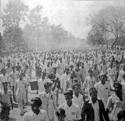
The Bengali Language Movement, also known as the Language Movement (Bhasha Andolon), was a political effort in Bangladesh (then known as East Pakistan), advocating the recognition of the Bengali language as an official language of Pakistan. Such recognition would allow Bengali to be taught in schools and used in government affairs. When the state of Pakistan was formed in 1947, its two regions, East Pakistan (also called East Bengal) and West Pakistan, were split along cultural, geographical, and linguistic lines. In 1948, the Government of Pakistan ordained Urdu as the sole national language, sparking extensive protests among the Bengali-speaking majority of East Pakistan. Facing rising sectarian tensions and mass discontent with the new law, the government outlawed public meetings and rallies. The students of the University of Dhaka and other political activists defied the law and organised a protest on 21 February 1952. The movement reached its climax when police killed student demonstrators on that day. The deaths provoked widespread civil unrest led by the Awami Muslim League, later renamed the Awami League. After years of conflict, the central government relented and granted official status to the Bengali language in 1956.
In 2000, UNESCO declared 21 February International Mother Language Day for the whole world to celebrate, in tribute to the Language Movement and the ethno-linguistic rights of people around the world.
The Language Movement catalysed the assertion of Bengali national identity in Pakistan, and became a forerunner to Bengali nationalist movements, including the 6-point movement and subsequently the Bangladesh Liberation War in 1971. In Bangladesh, 21 February is observed as Language Movement Day, a national holiday. The Shaheed Minar monument was constructed near Dhaka Medical College in memory of the movement and its victims.

The Bengali Language Movement, also known as the Language Movement (Bhasha Andolon), was a political effort in Bangladesh (then known as East Pakistan), advocating the recognition of the Bengali language as an official language of Pakistan. Such recognition would allow Bengali to be taught in schools and used in government affairs. When the state of Pakistan was formed in 1947, its two regions, East Pakistan (also called East Bengal) and West Pakistan, were split along cultural, geographical, and linguistic lines. In 1948, the Government of Pakistan ordained Urdu as the sole national language, sparking extensive protests among the Bengali-speaking majority of East Pakistan. Facing rising sectarian tensions and mass discontent with the new law, the government outlawed public meetings and rallies. The students of the University of Dhaka and other political activists defied the law and organised a protest on 21 February 1952. The movement reached its climax when police killed student demonstrators on that day. The deaths provoked widespread civil unrest led by the Awami Muslim League, later renamed the Awami League. After years of conflict, the central government relented and granted official status to the Bengali language in 1956.
In 2000, UNESCO declared 21 February International Mother Language Day for the whole world to celebrate, in tribute to the Language Movement and the ethno-linguistic rights of people around the world.
The Language Movement catalysed the assertion of Bengali national identity in Pakistan, and became a forerunner to Bengali nationalist movements, including the 6-point movement and subsequently the Bangladesh Liberation War in 1971. In Bangladesh, 21 February is observed as Language Movement Day, a national holiday. The Shaheed Minar monument was constructed near Dhaka Medical College in memory of the movement and its victims.

Tuesday, 17 February 2009
AUCTION OF GANDHI'S BELONGINGS -- AN IGNOMINY
Gandhi belongings for sale
Published Date: 13 February 2009
MAHATMA Gandhi's distinctive wire-framed spectacles, a pair of worn leather sandals and an inexpensive pocket watch are to go for auction in New York City.
Announcing the sale yesterday, Antiquorum Auctioneers said the auction of Gandhi's belongings was historic because the leader of India's independence movement, who died in 1948, had few possessions.All the items, including a simple brass bowl and plate, will be sold as a single lot during the sale on 4-5 March, with a reserve price of $20,000 to $30,000 (£14,000 to £21,000).The auction house said that in the past few days it had received inquiries from prospective buyers around the globe. The items belonged to a private American collector who obtained them from the Gandhi family's heirs.
The full article contains 133 words and appears in The Scotsman newspaper.
NEWS. Scotsman.com
Gandhi heirs condemn auction of his belongings
Published Date:16 February 2009
>>The family of Mahatma Gandhi has denounced a planned auction of his belongings as immoral and called for them to be returned to India as national treasures.
Gandhi's sandals, pocket watch and spectacles, which the father of the Indian independence movement said gave him "the vision to free India," will be sold to the highest bidder at a New York auction house next month, but last night his great-grandson joined Indian MPs in demanding their return.
Tushar Gandhi, Gandhi's 49-year-old great grandson who runs the Mahatma Gandhi Foundation in Mumbai, said he has already had offers from people around the world to donate one month's salary – including one from a poor rickshaw driver in Mumbai who had offered to sell his vehicle to raise money for the cause.
He has questioned the manner in which Peter Ruhe, a German memorabilia collector and chairman of the GandhiServe Foundation in Berlin, had obtained the items.
The watch, he claimed, was a gift from Gandhi to his grand niece-in-law who served as his personal assistant and in whose arms he died after being shot in 1948. He said that Mr Ruhe persuaded her to sign an agreement with him and now that she has died he is selling them off. He has gone around the world collecting up Gandhi's personal possessions and running it like a business.
"It is all very sad," he said.
"It is immoral and must be stopped," said Mr Gandhi. "It would be a grave insult to the nation if these items were just sold off. While my great-grandfather attached little importance to his possessions and lived a simple life, they are hugely sentimental items for the people.
"They are priceless to India. the father of the Indian independence movement. I would absolutely hate it if they ended up enriching the life of some wealthy businessman in America or Britain.
"They belong here."
The reserve price for the lot is £30,000, but experts expect bids of several times that amount.
The brochure for the New York auction house Antiquorum states that Gandhi gave the pocket watch to his grandniece Abha Gandhi. She later left it her own will to her daughter Ghita Mehta who has provided a letter of authenticity for the sale.
Nilay Band, an associate of Peter Ruhe and a member of his research organisation GandhiServe which promotes Gandhian philosophy, denied that Mr Ruhe had behaved in an underhand manner.
"I have no doubt that Mr Ruhe is genuine and has acquired his large collection on Gandhi memorabilia legitimately. He's a good man and very genuine," he said.
According to Tushar Gandhi, Mr Ruhe had travelled through Gujarat in the 1990s gathering Gandhi memorabilia and had met Gandhi's grandniece and acquired the rights to Gandhi's pocket watch from her. "Collecting up these items has been a systematic lucrative operation going on from Germany," he said.<<
Telegraph.co.uk
Published Date: 13 February 2009
MAHATMA Gandhi's distinctive wire-framed spectacles, a pair of worn leather sandals and an inexpensive pocket watch are to go for auction in New York City.
Announcing the sale yesterday, Antiquorum Auctioneers said the auction of Gandhi's belongings was historic because the leader of India's independence movement, who died in 1948, had few possessions.All the items, including a simple brass bowl and plate, will be sold as a single lot during the sale on 4-5 March, with a reserve price of $20,000 to $30,000 (£14,000 to £21,000).The auction house said that in the past few days it had received inquiries from prospective buyers around the globe. The items belonged to a private American collector who obtained them from the Gandhi family's heirs.
The full article contains 133 words and appears in The Scotsman newspaper.
NEWS. Scotsman.com
Gandhi heirs condemn auction of his belongings
Published Date:16 February 2009
>>The family of Mahatma Gandhi has denounced a planned auction of his belongings as immoral and called for them to be returned to India as national treasures.
Gandhi's sandals, pocket watch and spectacles, which the father of the Indian independence movement said gave him "the vision to free India," will be sold to the highest bidder at a New York auction house next month, but last night his great-grandson joined Indian MPs in demanding their return.
Tushar Gandhi, Gandhi's 49-year-old great grandson who runs the Mahatma Gandhi Foundation in Mumbai, said he has already had offers from people around the world to donate one month's salary – including one from a poor rickshaw driver in Mumbai who had offered to sell his vehicle to raise money for the cause.
He has questioned the manner in which Peter Ruhe, a German memorabilia collector and chairman of the GandhiServe Foundation in Berlin, had obtained the items.
The watch, he claimed, was a gift from Gandhi to his grand niece-in-law who served as his personal assistant and in whose arms he died after being shot in 1948. He said that Mr Ruhe persuaded her to sign an agreement with him and now that she has died he is selling them off. He has gone around the world collecting up Gandhi's personal possessions and running it like a business.
"It is all very sad," he said.
"It is immoral and must be stopped," said Mr Gandhi. "It would be a grave insult to the nation if these items were just sold off. While my great-grandfather attached little importance to his possessions and lived a simple life, they are hugely sentimental items for the people.
"They are priceless to India. the father of the Indian independence movement. I would absolutely hate it if they ended up enriching the life of some wealthy businessman in America or Britain.
"They belong here."
The reserve price for the lot is £30,000, but experts expect bids of several times that amount.
The brochure for the New York auction house Antiquorum states that Gandhi gave the pocket watch to his grandniece Abha Gandhi. She later left it her own will to her daughter Ghita Mehta who has provided a letter of authenticity for the sale.
Nilay Band, an associate of Peter Ruhe and a member of his research organisation GandhiServe which promotes Gandhian philosophy, denied that Mr Ruhe had behaved in an underhand manner.
"I have no doubt that Mr Ruhe is genuine and has acquired his large collection on Gandhi memorabilia legitimately. He's a good man and very genuine," he said.
According to Tushar Gandhi, Mr Ruhe had travelled through Gujarat in the 1990s gathering Gandhi memorabilia and had met Gandhi's grandniece and acquired the rights to Gandhi's pocket watch from her. "Collecting up these items has been a systematic lucrative operation going on from Germany," he said.<<
Telegraph.co.uk
Sunday, 15 February 2009
GLIMPSES OF BANGLA HISTORY
The First Bengali Book “the Charyapada“, exposes cover up behind anti-
Buddhist riots in the Sen Dynasty. Bengali speaking communities at home and abroad
respected the Centenary (1907 – 2007) Discovery Anniversary of First Bengali Literature
“The Charyapada (An Anthology of Buddhist Tantric Songs}”is the source of Assamese,
Marathi, Bangla, Punjabi, Hindi and Orissa languages and it was discovered by great
scholar Haraprasad Shastri from the Royal library of Nepal. It was sad time in the
Karnataka’s Hindu Sen dynasty and Brahmin rulers who destroyed Buddhist Pala dynasty
and the stronghold of Buddhist community. How did Brahmanism absorb Buddhism in
India? (Pandit J. Nehru’s book entitled Discovery of India indicates a professor of the
Paris University asked to Pandit Jawaharlal Nehru in 1941 in Paris, France).
The conspiracy of Halayud Mishra and Hari Sen with the Baktiar Khilj’s Army
and the carnage that followed in Bangladesh and other parts of India where infuriated
mobs went about killing, burning and looting of the Buddhist community. Naturally “The
Charyapada”, the ancient Buddhist literature is not what the people might call a general
Bengali book. Based on those horrible events the Buddhist poets and scholars decided to
plunge into a subject that cried out to be brought to light. Bangladesh Buddhist
community did not believe in the Vedic caste system. So in those days and nights that
followed, thousands of Buddhists monks and people were massacred as “retribution” of
caste system in a carnage organized by king Ballal Sen’s prime minister cum –
commander in chief Halayud Mishra, Hari Sen and Bakhtiar Khilji mafia as the great
writer Mr. Shaokat Ali explained in his Bengali books entitled, “Duskaler -Dibanishi”
and “Prodoshe Prakritjan.” There were survivors languished for months and later
millions of Buddhists were converted into Islam and received political support from the
Bakhtiar Khilji’s new kingdom Bangladesh. Bengali people are now reawakening to the
worst tragedy of the Buddhist Holocaust which was conspired by Brahmin mafia. Even
now questions are being raised and solutions are being sought. The history of Charyapada
was means to provoke, enrage, empower enlighten and most importantly open grounds
for discussion.
Even the millennium years later, holocaust victims Buddhist community are still
waiting for justice who destroyed Buddhist temples, monks and communities in the name
so called religions. The logic is “why bring up a history that is best buried and forgotten?
Why unearth the horrors of yesterday?” We don’t want to embarrass our Hindu, Brahmin
and Muslim neighbors and friends. But we have to share the pain of the events of the
historical holocaust. Buddhists have left deep wounds on both of our neighbors.
Charyapada’s poetry no 33 explained of regrets over Hindu fundamentalism.
Today the Rastriya Swayamsevak Sangh (RSS) and Vishwa Hindu Parishad (VHP)
members took over the Buddha Gaya Mahabodhi Temple in the name of its management
committee. While basking in the glory of being “the world’s second fastest growing
economy, we should also ponder on why Indians are at the same time among the most
back- ward looking and feudal minded societies in the world. In India the peace loving
people and the Dalits convert to Buddhism for peace and social justice every day. How
will Buddhism survive in Bangladesh?
2
In South Asia there are many people could not study Buddhism who are not
Buddhists. So the Indian Skeptic, a newsletter exposing many of the irrational goings on
relating to continuing superstition reigns. Sadly, few listen, because a bewildering variety
of Fakirs, Pir, Babas, swamis, priests and the like continue to exert a strangle hold over
the minds of the people. The tragedy of Hindu caste system and Islamic fundamentalists
do not allow Buddhism to preach in public places, temples and schools.
Dr. Syed Ali Ahsan said, “Carya means that which should be followed or
practiced and ‘Acarya’ which should not be. In fact these songs give instructions
regarding mystic practices.” UNESCO proclaimed that 21st February is the International
Mother Language Day in 1999 to honor the many languages in the world. The resolution
was sponsored by Bangladesh and adopted unanimously by the Member States of
UNESCO. To commemorate the historical occasion of Bangladesh every year UNESCO
proudly declared, “We pay tribute to the people of Bangladesh, whose passion for their
own language has inspired the designation of 21st February as the “International
Mother Language Day.”
Its history recorded that in 1948 being the father of the nation late Muhammad Ali
Jinnah declared in Dhaka (then it was East Pakistan), that Pakistan’s national language
will be Urdu. History speaks on this day of 21st February in 1952, when a number of
valiant sons of Bangladesh including Rafiq, Salam, Barkat, Jabbar and Shafiq sacrificed
their lives in Pakistani police firing to establish the state language of the erstwhile East
Pakistan which is today’s Bangladesh. After the series of movements, the Pakistan
government bowed down to the demand of the Bengali people and endorsed the Bengali
as one of the state languages. Time and tide wait for none and may all beings be happy.
International Mother Language Day and Nalanda University are gifts of Bengali
Minds to the world. Ancient Bengali book – the Charyapada was written around 8th –
12th century A. D. Hindu fundamentalists and Sen dynasty of Karnatak took over the
political power from Buddhist Pala kings of Bangladesh who established famous Nalanda
University in Bihar. At first Hindu fundamentalists confiscated native Buddhists and
neighbors mother language, books and survival. Hindu rulers and native Buddhists were
fighting continue. In the historical crossroads, during the 12th century Bakhtiar Khilji
attacked Bihar and Bengal and his Muslim Turks’ blazing fires reduced nine million
books of the ancient Nalanda Universtiy into ashes. Today in Bangladesh Muslims
fundamentalists dispossessed the Buddhists and indigenous people including Chakmas &
Marama of Chittagong Hilltracts as well as elsewhere of their ancestral land dwelling
houses by sending Muslim settlers accompanied by Bangladesh armed forces. Present Dr.
Fakhruddin Government does not take any of its political minister or advisor from the
Buddhist community of Bangladesh. Justice denied and persecution directly conducted
by the Jamat and Al-Quida Islamic fundamentalists. Bangladesh indigenous people
demanded their constitutional rights protect their democratic human development and
justice “without fear or favor.”
Bengali language is the source of power of people of Bangladesh as the Bengali
great scholar Atish Dipankar was the vice-chancellor of the Nalanda University who
established peace and educational systems in Tibet. There is a Tibetan translation of
Charyapada in Tibet. Pakistan government wanted to destroy the Bengali language in
1948 in East Pakistan which is today’s Bangladesh. Taliban and Al-Quida have destroyed
3
Afghanistan’s Bamian Buddha statues in 2001. Many great Muslim minded people told
that Taliban is disgrace to Islam and human civilization.
As the Indian Mass media reported that recently China and Japan governments
propose the Indian government to invest millions of dollars to develop the great Nalanda
University. We have to request the Bangladesh government to participate in the
development of our ancient Bengali king Dharmapal’s Nalanda University where many
world scholars came to study including famous Chinese Buddhist monk Huen Tsang in
the 8th century. Unfortunately, Ramayana’s Ayudhya chapter, verse no 32 it is well
documented and recorded, “Buddha is like a thief, know the Buddha as an atheist.” Thus
the Hindu fundamentalists eradicated of Buddhist culture from India and even now
Buddhagaya Mahabodhi temple is controlled by Hindu system of the Management
Committee. Any Religious fundamentalists are the enemies of world peace.
Mr. Sona Kanti Barua
The writer is the President of Bangladesh Buddhist Council, Toronto.
barua_s@hotmail.com
Buddhist riots in the Sen Dynasty. Bengali speaking communities at home and abroad
respected the Centenary (1907 – 2007) Discovery Anniversary of First Bengali Literature
“The Charyapada (An Anthology of Buddhist Tantric Songs}”is the source of Assamese,
Marathi, Bangla, Punjabi, Hindi and Orissa languages and it was discovered by great
scholar Haraprasad Shastri from the Royal library of Nepal. It was sad time in the
Karnataka’s Hindu Sen dynasty and Brahmin rulers who destroyed Buddhist Pala dynasty
and the stronghold of Buddhist community. How did Brahmanism absorb Buddhism in
India? (Pandit J. Nehru’s book entitled Discovery of India indicates a professor of the
Paris University asked to Pandit Jawaharlal Nehru in 1941 in Paris, France).
The conspiracy of Halayud Mishra and Hari Sen with the Baktiar Khilj’s Army
and the carnage that followed in Bangladesh and other parts of India where infuriated
mobs went about killing, burning and looting of the Buddhist community. Naturally “The
Charyapada”, the ancient Buddhist literature is not what the people might call a general
Bengali book. Based on those horrible events the Buddhist poets and scholars decided to
plunge into a subject that cried out to be brought to light. Bangladesh Buddhist
community did not believe in the Vedic caste system. So in those days and nights that
followed, thousands of Buddhists monks and people were massacred as “retribution” of
caste system in a carnage organized by king Ballal Sen’s prime minister cum –
commander in chief Halayud Mishra, Hari Sen and Bakhtiar Khilji mafia as the great
writer Mr. Shaokat Ali explained in his Bengali books entitled, “Duskaler -Dibanishi”
and “Prodoshe Prakritjan.” There were survivors languished for months and later
millions of Buddhists were converted into Islam and received political support from the
Bakhtiar Khilji’s new kingdom Bangladesh. Bengali people are now reawakening to the
worst tragedy of the Buddhist Holocaust which was conspired by Brahmin mafia. Even
now questions are being raised and solutions are being sought. The history of Charyapada
was means to provoke, enrage, empower enlighten and most importantly open grounds
for discussion.
Even the millennium years later, holocaust victims Buddhist community are still
waiting for justice who destroyed Buddhist temples, monks and communities in the name
so called religions. The logic is “why bring up a history that is best buried and forgotten?
Why unearth the horrors of yesterday?” We don’t want to embarrass our Hindu, Brahmin
and Muslim neighbors and friends. But we have to share the pain of the events of the
historical holocaust. Buddhists have left deep wounds on both of our neighbors.
Charyapada’s poetry no 33 explained of regrets over Hindu fundamentalism.
Today the Rastriya Swayamsevak Sangh (RSS) and Vishwa Hindu Parishad (VHP)
members took over the Buddha Gaya Mahabodhi Temple in the name of its management
committee. While basking in the glory of being “the world’s second fastest growing
economy, we should also ponder on why Indians are at the same time among the most
back- ward looking and feudal minded societies in the world. In India the peace loving
people and the Dalits convert to Buddhism for peace and social justice every day. How
will Buddhism survive in Bangladesh?
2
In South Asia there are many people could not study Buddhism who are not
Buddhists. So the Indian Skeptic, a newsletter exposing many of the irrational goings on
relating to continuing superstition reigns. Sadly, few listen, because a bewildering variety
of Fakirs, Pir, Babas, swamis, priests and the like continue to exert a strangle hold over
the minds of the people. The tragedy of Hindu caste system and Islamic fundamentalists
do not allow Buddhism to preach in public places, temples and schools.
Dr. Syed Ali Ahsan said, “Carya means that which should be followed or
practiced and ‘Acarya’ which should not be. In fact these songs give instructions
regarding mystic practices.” UNESCO proclaimed that 21st February is the International
Mother Language Day in 1999 to honor the many languages in the world. The resolution
was sponsored by Bangladesh and adopted unanimously by the Member States of
UNESCO. To commemorate the historical occasion of Bangladesh every year UNESCO
proudly declared, “We pay tribute to the people of Bangladesh, whose passion for their
own language has inspired the designation of 21st February as the “International
Mother Language Day.”
Its history recorded that in 1948 being the father of the nation late Muhammad Ali
Jinnah declared in Dhaka (then it was East Pakistan), that Pakistan’s national language
will be Urdu. History speaks on this day of 21st February in 1952, when a number of
valiant sons of Bangladesh including Rafiq, Salam, Barkat, Jabbar and Shafiq sacrificed
their lives in Pakistani police firing to establish the state language of the erstwhile East
Pakistan which is today’s Bangladesh. After the series of movements, the Pakistan
government bowed down to the demand of the Bengali people and endorsed the Bengali
as one of the state languages. Time and tide wait for none and may all beings be happy.
International Mother Language Day and Nalanda University are gifts of Bengali
Minds to the world. Ancient Bengali book – the Charyapada was written around 8th –
12th century A. D. Hindu fundamentalists and Sen dynasty of Karnatak took over the
political power from Buddhist Pala kings of Bangladesh who established famous Nalanda
University in Bihar. At first Hindu fundamentalists confiscated native Buddhists and
neighbors mother language, books and survival. Hindu rulers and native Buddhists were
fighting continue. In the historical crossroads, during the 12th century Bakhtiar Khilji
attacked Bihar and Bengal and his Muslim Turks’ blazing fires reduced nine million
books of the ancient Nalanda Universtiy into ashes. Today in Bangladesh Muslims
fundamentalists dispossessed the Buddhists and indigenous people including Chakmas &
Marama of Chittagong Hilltracts as well as elsewhere of their ancestral land dwelling
houses by sending Muslim settlers accompanied by Bangladesh armed forces. Present Dr.
Fakhruddin Government does not take any of its political minister or advisor from the
Buddhist community of Bangladesh. Justice denied and persecution directly conducted
by the Jamat and Al-Quida Islamic fundamentalists. Bangladesh indigenous people
demanded their constitutional rights protect their democratic human development and
justice “without fear or favor.”
Bengali language is the source of power of people of Bangladesh as the Bengali
great scholar Atish Dipankar was the vice-chancellor of the Nalanda University who
established peace and educational systems in Tibet. There is a Tibetan translation of
Charyapada in Tibet. Pakistan government wanted to destroy the Bengali language in
1948 in East Pakistan which is today’s Bangladesh. Taliban and Al-Quida have destroyed
3
Afghanistan’s Bamian Buddha statues in 2001. Many great Muslim minded people told
that Taliban is disgrace to Islam and human civilization.
As the Indian Mass media reported that recently China and Japan governments
propose the Indian government to invest millions of dollars to develop the great Nalanda
University. We have to request the Bangladesh government to participate in the
development of our ancient Bengali king Dharmapal’s Nalanda University where many
world scholars came to study including famous Chinese Buddhist monk Huen Tsang in
the 8th century. Unfortunately, Ramayana’s Ayudhya chapter, verse no 32 it is well
documented and recorded, “Buddha is like a thief, know the Buddha as an atheist.” Thus
the Hindu fundamentalists eradicated of Buddhist culture from India and even now
Buddhagaya Mahabodhi temple is controlled by Hindu system of the Management
Committee. Any Religious fundamentalists are the enemies of world peace.
Mr. Sona Kanti Barua
The writer is the President of Bangladesh Buddhist Council, Toronto.
barua_s@hotmail.com
CAMPAIGN FOR THE RETURN OF THE KOHINOOR (DIAMOND)
The Kohinoor diamond, appropriated during the British Raj was rumoured to be soon gifted to the queen-in-waiting, Camilla Parker Bowles.
The Kohinoor was usurped by the British during their colonial rule over India. It is not any personal property that could be passed on to the queen's daughter-in-law.
http://www.bbc.co.uk/dna/h2g2/A730801
http://en.wikipedia.org/wiki/Koh-i-Noor
The Kohinoor was usurped by the British during their colonial rule over India. It is not any personal property that could be passed on to the queen's daughter-in-law.
http://www.bbc.co.uk/dna/h2g2/A730801
http://en.wikipedia.org/wiki/Koh-i-Noor
Subscribe to:
Posts (Atom)

