Dutch-Australian William A S Ouderland was honoured with the state insignia of 'Bir Pratik ', the fourth highest gallantry award by the government of Bangladesh for his very active participation in and heroic contribution, to the WAR OF LIBERATION in 1971. He is the only foreigner to receive this honorary award by the government of Bangladesh. An Australian national Ouderland was born at Amsterdam in Netherland on 6 December 1917. At the age of seventeen he took a job in the Bata Shoe Company as Shoe-shiner (1934). After two years he left the job and joined National Service and was a Sergeant in the Royal Signal Corps (1936). He left the service in 1940 and then participated in the Second World War (1939-1945) as a guerilla commando of the Dutch army.
Ouderland first came to Dhaka in late 1970 with an assignment as the Production Manager of Bata Shoe Company. Within a few months he was promoted to the post of Company Manager. With the beginning of the War of Liberation the company-manager Ouderland discovered in him the ex-soldier Ouderland facing a new war. At the initial stage he engaged himself in communicating secret intelligence on the plans and actions of the occupation army to the freedom fighters.
As a foreigner he had the access to Pak-army and thereby the opportunity to move in the army headquarters and often attend meetings of the army officers in the cantonment. He helped the freedom fighters in every possible way by supplying provisions and financial support. With his experience in the Second World War as a guerilla commando and himself being an active member of a guerilla branch of the freedom fighters of Sector 2, he imparted regular training to the freedom fighters in guerilla warfare at different secret camps in Tongi including the Bata Shoe Factory premises.
On 25 March 1971, rising political discontent and cultural nationalism in East Pakistan was met by brutal suppressive force from the ruling elite of the West Pakistan establishment in what came to be termed Operation Searchlight. He was moved by the killings of the Pakistan Army on 25 March and took photos which he sent to the international media. A war between the West Pakistan Army and guerrilla force, the Mukti Bahini, started immediately. Guerrilla operations, which slacked during the training phase, picked up after August. Economic and Military targets in Dhaka were attacked. Ouderland organized the guerrilla warfare in Dhaka. He built a friendly relationship with 22nd Baluch Regiment captain Sultan Newaz and penetrated into Dhaka cantonment. Subsequently he created close relation with Governor General Tikka Khan and Adviser Civil Affairs Major General Rao Forman Ali. He became a "Distinguished Friend" of A. A. K. Niazi at the headquarters of Eastern Command and managed a security pass to contact with them frequently. Besides Ouderland continued gathering information for the Mukti Bahini and sent it to Major ATM Haider of Sector-2 and Ziaur Rahman.
Inside his office of the Bata Company in Tongi, Ouderland organized and trained the guerrilla fighters of Mukti Bahini. He planned and directed a number of guerrilla operations in Dhaka and nearby areas. He provided the fighters with food and medicine and often gave them shelter. Simultaneously, he gave a tremendous service at the initial stage of the Liberation War by collecting photographs on the inhuman torture and genocide by the occupation army in East Pakistan, and sending them to the world news media thereby creating public opinion in favour of Liberation War. On this point he wrote, "I recollected and resumed in myself the experiences of my youth in Europe, and I felt that I should get the world informed of what was happening in Bangladesh".
William AS Ouderland continued his service in the Bata Shoe Company with his later elevated position as Managing Director till 1978 when he retired and returned back to Australia and settled there for the rest of his life. He died on 18 May 2001 in a hospital at Perth in West Australia leaving behind him his wife Maria and his only daughter. In his last days he was often found telling his wife and daughter, "Bangladesh mon amor (Bangladesh is our love). Maintain this flow of emotion for the generation to come". In 1998, he was invited by the Prime Minister of Bangladesh, Sheikh Hasina, to receive the award and certificate but was unable to attend due to illness.
Courtesy: en.wikipedia.org/banglapedia.net/
Showing posts with label Edited by hrs. Show all posts
Showing posts with label Edited by hrs. Show all posts
Wednesday, 22 April 2009


Friday, 6 March 2009
Speech of Bongobondhu Sheikh Mujibur Rahman delivered on 7 March 1971 (English Version)
My dear brothers…..
I have come before you today with a heavy heart.
All of you know how hard we have tried. But it is a matter of sadness that the streets of Dhaka, Chittagong, Khulna, Rangpur and Rajshahi are today being spattered with the blood of my brothers, and the cry we hear from the Bengali people is a cry for freedom a cry for survival, a cry for our rights.
You are the ones who brought about an Awami League victory so you could see a constitutional government restored. The hope was that the elected representatives of the people, sitting in the National Assembly, would formulate a constitution that would assure that people of their economic, political and cultural emancipation.
But now, with great sadness in my heart, I look back on the past 23 years of our history and see nothing but a history of the shedding of the blood of the Bengali people. Ours has been a history of continual lamentation, repeated bloodshed and innocent tears.
We gave blood in 1952, we won a mandate in 1954. But we were still not allowed to take up the reins of this country. In 1958, Ayub Khan clamped Martial Law on our people and enslaved us for the next 10 years. In 1966, during the Six-Point Movement of the masses, many were the young men and women whose lives were stilled by government bullets.
After the downfall of Ayub, Mr. Yahya Khan took over with the promise that he would restore constitutional rule, that he would restore democracy and return power to the people.
We agreed. But you all know of the events that took place after that I ask you, are we the ones to blame?
As you know, I have been in contract with President Yahya Khan. As leader of the majority part in the national Assembly, I asked him to set February 15 as the day for its opening session. He did not accede to the request I made as leader of the majority party. Instead, he went along with the delay requested by the minority leader Mr. Bhutto and announced that the Assembly would be convened on the 3rd of March.
We accepted that, agreed to join the deliberations. I even went to the extent of saying that we, despite our majority, would still listen to any sound ideas from the minority, even if it were a lone voice. I committed myself to the support of anything to bolster the restoration of a constitutional government.
When Mr. Bhutto came to Dhaka, we met. We talked. He left, sing that the doors to negotiation were still open. Moulana Noorani and Moulana Mufti were among those West Pakistan parliamentarians who visited Dhaka and talked with me about an agreement on a constitutional framework.
I made it clear that could not agree to any deviation from the Six Points. That right rested with the people. Come, I said, let us sit down and resolve matters.
But Bhutto’s retort was that he would not allow himself to become hostage on two fronts. He predicted that if any West Pakistani members of Parliament were to come to Dhaka, the Assembly would be turned into a slaughterhouse. He added that if anyone were to participate in such a session, a countrywide agitation would be launched from Peshawar to Karachi and that ever business would be shut down in protest.
I assured him that the Assembly would be convened and despite the dire threats, West Pakistani leaders did come down to Dhaka.
But suddenly, on March I, the session was cancelled.
There was an immediate outcry against this move by the people. I called for a hartal as a peaceful form of protest and the masses redial took to the streets in response.
And what did we get as a response?
He turned his guns on my helpless people, a people with no arms to defend themselves. These were the same arms that had been purchased with our own money to protect us from external enemies. But it is my own people who are being fired upon today.
In the past, too, each time we the numerically larger segment of Pakistan’s population-tried to assert our rights and control our destiny, the conspired against us and pounced upon us.
I have asked them this before : How can you make your own brothers the target of your bullets?
Now Yahya Khan says that I had agreed to a Round Table Conference on the 10th. Let me point out that is not true.
I had said, Mr. Yahya Khan, your are the President of this country. Come to Dhaka, come and see how our poor Bengali people have been mown down by your bullets, how the laps of our mothers and sisters have been robbed and left empty and bereft, how my helpless people have been slaughtered. Come, I said, come and see for yourself and then be the judge and decide. That is what I told him.
Earlier, I had told him there would be no Round Table Conference. What Round Table Conference, whose Round Table Conference? You expect me to sit at a Round Table Conference with the very same people who have emptied the laps of my mothers and my sisters?
On the 3rd, at the Paltan, I called for a non-cooperation movement and the shutdown of offices, courts and revenue collection. You gave me full support.
Then suddenly, without consulting me or even informing us, he met with one individual for five hours and then made a speech in which he trend all the blame on me, laid all the fault at the door of the Bengali people!
The deadlock was created by Bhutto, yet the Bengalis are the ones facing the bullets! We face their guns, yet its our fault. We are the ones being bit by their bullets- and its still our fault!
So, the struggle this time is a struggle for emancipation, the struggle this time is a struggle for independence!
Brothers, they have now called the Assembly to assassin on March 25, with the streets not yet dry of the blood of my brothers. You have called the Assembly, but you must first agree to meet my demands. Martial Law must be withdrawn; the soldiers must return to their barracks; the murderers of my people must be redressed. And …. Power must be handed over to the elected representatives of the people.
Only then will we consider if we can take part in the National Assembly or not!
Before these demands are met, there can be no question of our participating in this session of the Assembly. That is one right not give to me as part of my mandate from the masses.
As I told them earlier, Mujibur Rahman refuses to walk to the Assembly trading upon the fresh stains of his brothers’ blood!
Do you, my brothers, have complete faith in me….?
…. Let me the tell you that the Prime Ministership is not what I seek. What I want is justice, the rights of the people of this land. They tempted me with the Prime Ministership but the failed to buy me over. Nor did the succeed in hanging me on the gallows, for your rescued me with your blood from the so-called conspiracy case.
That day, right here at this racecourse, I had pledge to you that I would pay for this blood debt with my own blood. Do you remember? I am read today to fulfill that promise!
I now declare the closure of all the courts, offices, and educational institutions for an indefinite period of time. No one will report to their offices- that is my instruction to you.
So that the poor are not inconvenienced, rickshaws, trains and other transport will ply normally-except serving any needs of the armed forces. If the army does not respect this, I shall not be responsible for the consequences.
The Secretariat, Supreme Court, High Court, Judge’s Courts, and government and semi-government offices shall remain shut. Only banks ma open for two hours daily for business transactions. But no money shall be transmitted from East to West Pakistan. The Bengali people must stay calm during these times. Telegraph and telephone communications will be confined within Bangladesh.
The people of this land are facing elimination, so be on guard. If need be, we will bring everything to a total standstill…….
Collect your salaries on time. If the salaries are held up, if a single bullet is fired upon us henceforth, if the murder of my people does not cease, I call upon you to turn ever home into a fortress against their onslaught. Use whatever you can put your hands on to confront this enemy. Ever last road must be blocked.
We will deprive them of food, we will deprive them of water. Even if I am not around to give you the orders, and if my associates are also not to be found, I ask you to continue your movement unabated.
I say to them again, you are my brothers, return now to the barracks where you belong and no one will bear any hostility toward you. Only do not attempt to aim any more bullets at our hearts: It will not do any good!
….. And the seven million people of this land will not be cowed down by you or accept suppression any more. The Bengali people have learned how to die for a cause and you will not be able to bring them under your yoke of suppression!
To assist the families of the martyred and the injured, the Awami League has set up committees that will do all they can. Please donate whatever you can. Also, employers must give full pay to the workers who participated in the seven days of hartal or were not able to work because of curfews.
To all government employees, I say that my directives must be followed. I had better not see any of you attending your offices. From today, until this land has been freed, no taxes will be paid to the government any more. As of now, the stop. Leave everything to me. I know how to organize movement.
But be very careful. Keep in mind that the enemy has infiltrated our ranks to engage in the work of provocateurs. Whether Bengali or non-Bengali, Hindu or Muslim, all is our brothers and it is our responsibility to ensure their safety.
I also ask you to stop listening to radio, television and the press if these media do not report news of our movement.
To them, I say, “You are our brothers. I beseech your to not turn this country into a living hell. With you not have to show your faces and confront your conscience some day?
If we can peaceably settle our differences there is still hope that we can co-exist as brothers. Otherwise there is no hope. If you choose the other path, we may never come face one another again.
For now, I have just one thing to ask of you: Give up any thoughts of enslaving this country under military rule again!”
I ask my people to immediately set up committees under the leadership of the Awami League to carry on our struggle in ever neighborhood, village, union and subdivision of this land.
You must prepare yourselves now with what little you have for the struggle ahead.
Since we have given blood, we will give more of it. But, Insha’Allah, we will free the people of this land!
The struggle this time is for emancipation! The struggle this time is for independence!
Be ready. We cannot afford to lose our momentum. Keep the movement and the struggle alive because if we fall back the will come down hard upon us.
Be disciplined. No nation’s movement can be victorious without discipline.
Joy Bangla!
Source :
POET OF POLITICS, FATHER OF THE NATION BANGABANDHU SHEIKH MUJIBUR RAHMAN Published by Father of the Nation Bangabandhu sheikh Mujibur Rahman Memorial Trust, Bangabandhu Bhaban, Road-32, Dhanmondi R/A, Dhaka-1205, Bangladesh.
I have come before you today with a heavy heart.
All of you know how hard we have tried. But it is a matter of sadness that the streets of Dhaka, Chittagong, Khulna, Rangpur and Rajshahi are today being spattered with the blood of my brothers, and the cry we hear from the Bengali people is a cry for freedom a cry for survival, a cry for our rights.
You are the ones who brought about an Awami League victory so you could see a constitutional government restored. The hope was that the elected representatives of the people, sitting in the National Assembly, would formulate a constitution that would assure that people of their economic, political and cultural emancipation.
But now, with great sadness in my heart, I look back on the past 23 years of our history and see nothing but a history of the shedding of the blood of the Bengali people. Ours has been a history of continual lamentation, repeated bloodshed and innocent tears.
We gave blood in 1952, we won a mandate in 1954. But we were still not allowed to take up the reins of this country. In 1958, Ayub Khan clamped Martial Law on our people and enslaved us for the next 10 years. In 1966, during the Six-Point Movement of the masses, many were the young men and women whose lives were stilled by government bullets.
After the downfall of Ayub, Mr. Yahya Khan took over with the promise that he would restore constitutional rule, that he would restore democracy and return power to the people.
We agreed. But you all know of the events that took place after that I ask you, are we the ones to blame?
As you know, I have been in contract with President Yahya Khan. As leader of the majority part in the national Assembly, I asked him to set February 15 as the day for its opening session. He did not accede to the request I made as leader of the majority party. Instead, he went along with the delay requested by the minority leader Mr. Bhutto and announced that the Assembly would be convened on the 3rd of March.
We accepted that, agreed to join the deliberations. I even went to the extent of saying that we, despite our majority, would still listen to any sound ideas from the minority, even if it were a lone voice. I committed myself to the support of anything to bolster the restoration of a constitutional government.
When Mr. Bhutto came to Dhaka, we met. We talked. He left, sing that the doors to negotiation were still open. Moulana Noorani and Moulana Mufti were among those West Pakistan parliamentarians who visited Dhaka and talked with me about an agreement on a constitutional framework.
I made it clear that could not agree to any deviation from the Six Points. That right rested with the people. Come, I said, let us sit down and resolve matters.
But Bhutto’s retort was that he would not allow himself to become hostage on two fronts. He predicted that if any West Pakistani members of Parliament were to come to Dhaka, the Assembly would be turned into a slaughterhouse. He added that if anyone were to participate in such a session, a countrywide agitation would be launched from Peshawar to Karachi and that ever business would be shut down in protest.
I assured him that the Assembly would be convened and despite the dire threats, West Pakistani leaders did come down to Dhaka.
But suddenly, on March I, the session was cancelled.
There was an immediate outcry against this move by the people. I called for a hartal as a peaceful form of protest and the masses redial took to the streets in response.
And what did we get as a response?
He turned his guns on my helpless people, a people with no arms to defend themselves. These were the same arms that had been purchased with our own money to protect us from external enemies. But it is my own people who are being fired upon today.
In the past, too, each time we the numerically larger segment of Pakistan’s population-tried to assert our rights and control our destiny, the conspired against us and pounced upon us.
I have asked them this before : How can you make your own brothers the target of your bullets?
Now Yahya Khan says that I had agreed to a Round Table Conference on the 10th. Let me point out that is not true.
I had said, Mr. Yahya Khan, your are the President of this country. Come to Dhaka, come and see how our poor Bengali people have been mown down by your bullets, how the laps of our mothers and sisters have been robbed and left empty and bereft, how my helpless people have been slaughtered. Come, I said, come and see for yourself and then be the judge and decide. That is what I told him.
Earlier, I had told him there would be no Round Table Conference. What Round Table Conference, whose Round Table Conference? You expect me to sit at a Round Table Conference with the very same people who have emptied the laps of my mothers and my sisters?
On the 3rd, at the Paltan, I called for a non-cooperation movement and the shutdown of offices, courts and revenue collection. You gave me full support.
Then suddenly, without consulting me or even informing us, he met with one individual for five hours and then made a speech in which he trend all the blame on me, laid all the fault at the door of the Bengali people!
The deadlock was created by Bhutto, yet the Bengalis are the ones facing the bullets! We face their guns, yet its our fault. We are the ones being bit by their bullets- and its still our fault!
So, the struggle this time is a struggle for emancipation, the struggle this time is a struggle for independence!
Brothers, they have now called the Assembly to assassin on March 25, with the streets not yet dry of the blood of my brothers. You have called the Assembly, but you must first agree to meet my demands. Martial Law must be withdrawn; the soldiers must return to their barracks; the murderers of my people must be redressed. And …. Power must be handed over to the elected representatives of the people.
Only then will we consider if we can take part in the National Assembly or not!
Before these demands are met, there can be no question of our participating in this session of the Assembly. That is one right not give to me as part of my mandate from the masses.
As I told them earlier, Mujibur Rahman refuses to walk to the Assembly trading upon the fresh stains of his brothers’ blood!
Do you, my brothers, have complete faith in me….?
…. Let me the tell you that the Prime Ministership is not what I seek. What I want is justice, the rights of the people of this land. They tempted me with the Prime Ministership but the failed to buy me over. Nor did the succeed in hanging me on the gallows, for your rescued me with your blood from the so-called conspiracy case.
That day, right here at this racecourse, I had pledge to you that I would pay for this blood debt with my own blood. Do you remember? I am read today to fulfill that promise!
I now declare the closure of all the courts, offices, and educational institutions for an indefinite period of time. No one will report to their offices- that is my instruction to you.
So that the poor are not inconvenienced, rickshaws, trains and other transport will ply normally-except serving any needs of the armed forces. If the army does not respect this, I shall not be responsible for the consequences.
The Secretariat, Supreme Court, High Court, Judge’s Courts, and government and semi-government offices shall remain shut. Only banks ma open for two hours daily for business transactions. But no money shall be transmitted from East to West Pakistan. The Bengali people must stay calm during these times. Telegraph and telephone communications will be confined within Bangladesh.
The people of this land are facing elimination, so be on guard. If need be, we will bring everything to a total standstill…….
Collect your salaries on time. If the salaries are held up, if a single bullet is fired upon us henceforth, if the murder of my people does not cease, I call upon you to turn ever home into a fortress against their onslaught. Use whatever you can put your hands on to confront this enemy. Ever last road must be blocked.
We will deprive them of food, we will deprive them of water. Even if I am not around to give you the orders, and if my associates are also not to be found, I ask you to continue your movement unabated.
I say to them again, you are my brothers, return now to the barracks where you belong and no one will bear any hostility toward you. Only do not attempt to aim any more bullets at our hearts: It will not do any good!
….. And the seven million people of this land will not be cowed down by you or accept suppression any more. The Bengali people have learned how to die for a cause and you will not be able to bring them under your yoke of suppression!
To assist the families of the martyred and the injured, the Awami League has set up committees that will do all they can. Please donate whatever you can. Also, employers must give full pay to the workers who participated in the seven days of hartal or were not able to work because of curfews.
To all government employees, I say that my directives must be followed. I had better not see any of you attending your offices. From today, until this land has been freed, no taxes will be paid to the government any more. As of now, the stop. Leave everything to me. I know how to organize movement.
But be very careful. Keep in mind that the enemy has infiltrated our ranks to engage in the work of provocateurs. Whether Bengali or non-Bengali, Hindu or Muslim, all is our brothers and it is our responsibility to ensure their safety.
I also ask you to stop listening to radio, television and the press if these media do not report news of our movement.
To them, I say, “You are our brothers. I beseech your to not turn this country into a living hell. With you not have to show your faces and confront your conscience some day?
If we can peaceably settle our differences there is still hope that we can co-exist as brothers. Otherwise there is no hope. If you choose the other path, we may never come face one another again.
For now, I have just one thing to ask of you: Give up any thoughts of enslaving this country under military rule again!”
I ask my people to immediately set up committees under the leadership of the Awami League to carry on our struggle in ever neighborhood, village, union and subdivision of this land.
You must prepare yourselves now with what little you have for the struggle ahead.
Since we have given blood, we will give more of it. But, Insha’Allah, we will free the people of this land!
The struggle this time is for emancipation! The struggle this time is for independence!
Be ready. We cannot afford to lose our momentum. Keep the movement and the struggle alive because if we fall back the will come down hard upon us.
Be disciplined. No nation’s movement can be victorious without discipline.
Joy Bangla!
Source :
POET OF POLITICS, FATHER OF THE NATION BANGABANDHU SHEIKH MUJIBUR RAHMAN Published by Father of the Nation Bangabandhu sheikh Mujibur Rahman Memorial Trust, Bangabandhu Bhaban, Road-32, Dhanmondi R/A, Dhaka-1205, Bangladesh.
Wednesday, 18 February 2009
INTERNATIONAL MOTHER LANGUAGE DAY 21 FEBRUARY AND BANGLADESH

International Mother Language Day
21 February was proclaimed the International Mother Language Day by UNESCO on 17 November 1999. The 21st of February is of special significance to the people of Bangladesh. At the request of the people of Bangladesh and after investigating the matter, UNESCO declared the 21st of February each year to be International Mother Language Day on a world-wide scale among United Nations member countries.
21 February was proclaimed the International Mother Language Day by UNESCO on 17 November 1999. The 21st of February is of special significance to the people of Bangladesh. At the request of the people of Bangladesh and after investigating the matter, UNESCO declared the 21st of February each year to be International Mother Language Day on a world-wide scale among United Nations member countries.
Each year the 21st of February is commemorated as Language Martyrs Day in Bangladesh and other parts of the world that have sizeable groups of Bangla-speaking people.
In 1999 the proposal was made to UNESCO to create International Mother Language Day in the belief that a culture of peace can only really flourish where each individual enjoys the right to communicate freely in their mother language in all aspects of their lives. UNESCO supports this conviction, as well as the belief that there should be cultural and linguistic diversity in education and the preservation of languages in danger of dying out. So at the 30th session of the General Conference of UNESCO in 1999 the decision was taken to launch International Mother Language Day throughout the world. Its observance was also formally recognized by the United Nations General Assembly in its resolution establishing 2008 as the International Year of Languages.
Bengali Language Movement 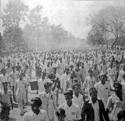
The Bengali Language Movement, also known as the Language Movement (Bhasha Andolon), was a political effort in Bangladesh (then known as East Pakistan), advocating the recognition of the Bengali language as an official language of Pakistan. Such recognition would allow Bengali to be taught in schools and used in government affairs. When the state of Pakistan was formed in 1947, its two regions, East Pakistan (also called East Bengal) and West Pakistan, were split along cultural, geographical, and linguistic lines. In 1948, the Government of Pakistan ordained Urdu as the sole national language, sparking extensive protests among the Bengali-speaking majority of East Pakistan. Facing rising sectarian tensions and mass discontent with the new law, the government outlawed public meetings and rallies. The students of the University of Dhaka and other political activists defied the law and organised a protest on 21 February 1952. The movement reached its climax when police killed student demonstrators on that day. The deaths provoked widespread civil unrest led by the Awami Muslim League, later renamed the Awami League. After years of conflict, the central government relented and granted official status to the Bengali language in 1956.
In 2000, UNESCO declared 21 February International Mother Language Day for the whole world to celebrate, in tribute to the Language Movement and the ethno-linguistic rights of people around the world.
The Language Movement catalysed the assertion of Bengali national identity in Pakistan, and became a forerunner to Bengali nationalist movements, including the 6-point movement and subsequently the Bangladesh Liberation War in 1971. In Bangladesh, 21 February is observed as Language Movement Day, a national holiday. The Shaheed Minar monument was constructed near Dhaka Medical College in memory of the movement and its victims.

The Bengali Language Movement, also known as the Language Movement (Bhasha Andolon), was a political effort in Bangladesh (then known as East Pakistan), advocating the recognition of the Bengali language as an official language of Pakistan. Such recognition would allow Bengali to be taught in schools and used in government affairs. When the state of Pakistan was formed in 1947, its two regions, East Pakistan (also called East Bengal) and West Pakistan, were split along cultural, geographical, and linguistic lines. In 1948, the Government of Pakistan ordained Urdu as the sole national language, sparking extensive protests among the Bengali-speaking majority of East Pakistan. Facing rising sectarian tensions and mass discontent with the new law, the government outlawed public meetings and rallies. The students of the University of Dhaka and other political activists defied the law and organised a protest on 21 February 1952. The movement reached its climax when police killed student demonstrators on that day. The deaths provoked widespread civil unrest led by the Awami Muslim League, later renamed the Awami League. After years of conflict, the central government relented and granted official status to the Bengali language in 1956.
In 2000, UNESCO declared 21 February International Mother Language Day for the whole world to celebrate, in tribute to the Language Movement and the ethno-linguistic rights of people around the world.
The Language Movement catalysed the assertion of Bengali national identity in Pakistan, and became a forerunner to Bengali nationalist movements, including the 6-point movement and subsequently the Bangladesh Liberation War in 1971. In Bangladesh, 21 February is observed as Language Movement Day, a national holiday. The Shaheed Minar monument was constructed near Dhaka Medical College in memory of the movement and its victims.

Subscribe to:
Posts (Atom)

